



































2027: APC Chieftain Faults Utomi, Says Parallel Election Results Undermines INEC's Mandate, Endangers Democracy
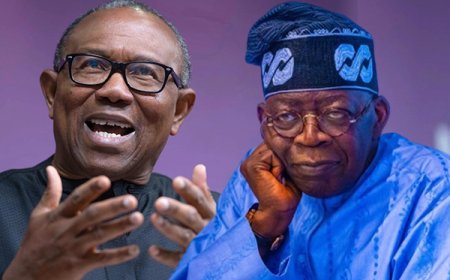
In a riveting intellectual and constitutional battle, a Chieftain of the APC, Dr. George Agbakahi has squared renowned political economist, Prof Pat Utomi over his proposal to set up alternate election results collation platform during the 2027 general elections.


Our Reporter


Abuja Nigeria - A chieftain of the All Progressives Congress and South-East Leader of the Tinubu Support Organisation, Dr George Agbakahi, has cautioned against proposals for political parties to operate parallel election result declaration systems, warning that such initiatives could undermine Nigeria's constitutional democracy and trigger political instability.
Agbakahi made the submission in a detailed statement titled, "Competing Electoral Verdicts and the Threat to Democratic Stability in Nigeria: The Perils of Parallel Result Declarations in Nigeria," which was presented as a rebuttal to a proposal attributed to political economist and former presidential candidate, Prof Pat Utomi.
The APC stalwart argued that the Independent National Electoral Commission (INEC) remains the only institution constitutionally empowered to authenticate and declare election results in Nigeria, stressing that any attempt by political parties, pressure groups or private organisations to establish alternative result declaration mechanisms would amount to an unconstitutional usurpation of state authority.
According to him, elections derive legitimacy not merely from the casting of votes but from the constitutional process through which results are authenticated and declared by authorised electoral officials.
He maintained that the Constitution and the Electoral Act provide a clear framework that vests responsibility for the conduct of elections and declaration of results exclusively in INEC and its designated officers.
He made reference to the Electoral Act 2022 (as amended) and the Electoral Act 2026.
"Section 25 of the Electoral Act provides for the announcement of election results by specifically authorised officers, beginning with Presiding Officers at polling units and extending through various levels of collation to Returning Officers at the state and national levels," he said.
According to him, this statutory arrangement derives its legitimacy from the Constitution itself.
"Paragraph 15 of Part I of the Third Schedule to the Constitution vests INEC with responsibility for organizing, undertaking, and supervising elections into elective offices established under the Constitution.
"Embedded within this responsibility is the authority to conduct the electoral process from commencement to conclusion, including the declaration of results," he maintained.
Agbakahi noted that while political parties are entitled to monitor elections, collect results from polling units, and challenge outcomes through lawful channels, they possess no legal authority to independently declare winners or authenticate electoral outcomes.
"Political parties may collect, collate, analyse and preserve election results for verification purposes, but possession of electoral data does not confer the authority to pronounce on the outcome of an election," he said.
The Chieftain explained that accredited party agents already have access to election results at polling units and collation centres, while technological platforms such as the Bimodal Voter Accreditation System and the INEC Result Viewing Portal provide additional avenues for monitoring electoral processes.
However, he stressed that access to election data should not be confused with the constitutional authority to declare results.
Agbakahi further argued that electoral grievances should be resolved through election petition tribunals and the courts rather than through what he described as "self-help" mechanisms capable of generating competing electoral verdicts.
Addressing arguments that independent result aggregation by political parties falls within the ambit of freedom of expression, he contended that constitutional rights are subject to lawful restrictions aimed at preserving public order and democratic stability.
He noted that the Electoral Act specifically identifies categories of electoral officers authorised to announce and declare election results and, by implication, excludes all other individuals and organisations from performing such functions.
The APC leader expressed particular concern over proposals advocating party-led real-time result transmission systems accessible to domestic and international audiences.
According to him, while such initiatives may be presented as transparency measures, they could create alternative centres of authority capable of challenging the legitimacy of official electoral outcomes.
"If every political party establishes and publicises independent result declaration systems, Nigeria's electoral space could become fragmented into multiple and conflicting narratives of electoral truth," he warned.
Agbakahi argued that such a development could undermine electoral finality, generate institutional confusion and provoke competing claims to political legitimacy.
Drawing an analogy with the judiciary, he said just as private citizens cannot establish parallel courts to issue binding judgments, political parties cannot establish parallel institutions to declare election results.
The APC chieftain also linked the issue to national security, warning that competing claims over electoral outcomes have historically contributed to political crises in Nigeria and other African countries.
He cited the Western Region political crisis of 1964–1965, the aftermath of the annulled June 12, 1993 presidential election and the violence that followed the 2011 presidential poll as examples of the dangers associated with disputed electoral legitimacy.
Agbakahi also referenced electoral crises in Kenya, Côte d'Ivoire and Zimbabwe, where conflicting claims over election outcomes contributed to violence, displacement and economic disruption.
He noted that Nigeria's current political climate, characterised by ethnic divisions, economic challenges, declining trust in public institutions and heightened political polarisation, makes the country particularly vulnerable to the dangers of competing electoral narratives ahead of the 2027 general elections.
The increasing influence of social media and digital communication platforms, he added, could further amplify misinformation and partisan interpretations of election results.
Agbakahi therefore urged the preservation of INEC's exclusive constitutional authority to declare election results, describing it as a safeguard essential to democratic stability, constitutional order and national security.
He also called for stricter enforcement of electoral laws against unauthorised result declarations and urged INEC to continue improving transparency through initiatives such as the Result Viewing Portal and real-time publication of polling-unit results.
The APC leader further recommended legislative measures to address emerging technological challenges while encouraging media organisations to clearly distinguish between official election results and partisan tallies.
According to him, Nigeria's democratic future depends on maintaining a single lawful and institutional source of electoral legitimacy.
"Electoral sovereignty must remain singular, lawful and institutional. Anything less risks undermining the very foundations of the Nigerian state," he stated.
What's Your Reaction?
 Like
0
Like
0
 Dislike
0
Dislike
0
 Love
0
Love
0
 Funny
0
Funny
0
 Angry
0
Angry
0
 Sad
0
Sad
0
 Wow
0
Wow
0