









Atom-Kpera: How Nzogwu & I Did Jan. '66 Coup, Became Gov in Enugu, Benue
John Atom Kpere narrates that Ben Gbulie and General Obasanjo were his immediate bosses in the Army Engineering before the January 1966 coup and the civil war

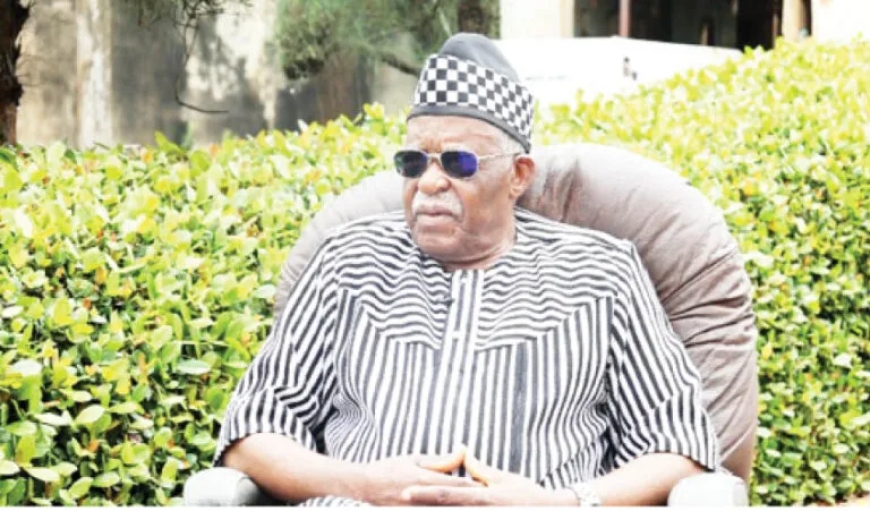
Brigadier-General John Atom Kpera’s military career is inseparable from some of the most turbulent chapters in Nigeria’s history.


A regular combatant officer who spent 24 years in the Nigerian military, Kpera witnessed the country’s first military coup in January 1966, fought in the Nigerian Civil War, and later found himself appointed military governor of the vast East Central State.
Years later, he would return to govern his home state, Benue, under the military regime of General Muhammadu Buhari.
Now retired for 41 years, Kpera has remained in his native Gboko, where he has lived a largely quiet life of farming and retirement.
His recollections offer a rare first-hand account of the events that shaped Nigeria in the years immediately before and after independence.
The night Exercise Damisa became a coup
Kpera was a young officer in the Nigerian Army Engineers in Kaduna when the January 1966 coup unfolded.
According to him, what the soldiers initially understood as a military exercise later turned out to be the beginning of Nigeria’s first military takeover.
“We had two nights. They called the first night of the coup, Exercise Damisa,” he recalled.
On the night of January 14, 1966, Kpera and his troops were deployed for what they believed was a night attack exercise.
His assignment was to surround Radio Nigeria in Kaduna and prevent anyone from entering or leaving the facility.
“We were there for about five hours,” he said, adding that his commanding officer, Captain Gbulie, later inspected the position and ordered them to stand down.
The following night, they returned to the field.
This time, Kpera was again ordered to surround Radio Nigeria and remain there until daybreak.
While he was at the location, instructions came for him to report to Brigade Headquarters.
There, he encountered Major Chukwuma Kaduna Nzeogwu, one of the principal figures in the coup.
Kpera said Nzeogwu addressed the soldiers and told them they had succeeded in putting Nigeria in a better shape.
“I was ignorant about that,” Kpera said.
It was only then, he recalled, that the soldiers were told that a coup had taken place and that the military had taken over.
“I just sat there and (he) said there was a coup,” he recalled.
Kpera’s account places him among the officers whose military duties brought them directly into the events of January 1966, although he maintains that he did not set out to participate in a coup.
From the coup to the Civil War
After the coup and the political upheavals that followed, Kpera remained in the Army Engineers.
When the Civil War broke out in 1967, he was commanding an engineering squadron and was deployed to the Ogoja area.
His role was largely centred on the difficult engineering demands of wartime.
“We were building bridges, breaking explosives the other side had planted,” he said.
The engineers, he explained, were responsible for keeping the military advance moving by constructing bridges, clearing obstacles and ensuring that roads remained accessible to troops and military vehicles.
“We did the normal thing we were trained to do – carry our troops, build the bridge, get the roads moving with the trucks and the army vehicles.”
For Kpera, the war was therefore experienced not only through combat but also through the painstaking engineering work required to sustain military operations.
An unexpected journey to Enugu
After the war, Kpera continued to rise through the ranks of the Nigerian Army.
By 1975, he was commanding a brigade of engineers in Ibadan when he received an unexpected signal ordering him to report to Dodan Barracks in Lagos.
He had no idea that the summons would change the direction of his career.
At Dodan Barracks, he first met General Olusegun Obasanjo, then Chief of Army Staff. Obasanjo asked him a question that caught him off guard.
“How about being a governor?” Obasanjo asked.
Kpera said he did not understand what he meant.
Obasanjo then took him to the office of General Murtala Muhammed, who had become Head of State after the 1975 coup against General Yakubu Gowon.
Murtala was equally direct.
“You are going to Enugu to be governor,” he told him.
Kpera said he was confused because nobody had previously discussed the appointment with him.
He returned to Obasanjo’s office, hoping for an explanation.
Instead, he was told to report to the airport the following morning. The Air Force would fly him to Enugu, where he was to take over from Colonel Anthony Ochefu.
“I rushed back to Ibadan, packed, and at 10 o’clock I was at the airport and they took me to Enugu,” he recalled.
Taking charge of the East Central State
Kpera arrived in Enugu as a lieutenant colonel and initially found himself face-to-face with his senior officer, Colonel Ochefu.
Rather than resist the transition, Ochefu welcomed him and explained that he was retiring.
More importantly, Ochefu handed Kpera his detailed notes on the state, including his observations and plans.
“I took over as the military governor of the East Central State in November 1975,” Kpera said.
The East Central State of that era was enormous compared with today’s southeastern states. Its territory would eventually be divided into several states, including what are now Enugu, Anambra, Imo, Abia and parts of other neighbouring states.
Kpera said he did not see the appointment as a personal elevation but as another military assignment.
“It was not overwhelming. It was a military duty,” he said.
He remembered, however, the warning given to him by Murtala Muhammed before he left Lagos.
“You are going there to take over as military governor; if I hear any stupid thing you will be sorry,” Murtala had told him.
Kpera took the warning seriously.
“I had that in mind. So I studied whatever Colonel Ochefu gave me.”
Surviving the Murtala assassination
Kpera’s tenure in the East Central State coincided with another major turning point in Nigeria's history.
In February 1976, Murtala Muhammed was assassinated during the failed coup led by Lieutenant Colonel Buka Suka Dimka.
General Olusegun Obasanjo became Head of State.
Kpera remained in office.
His relationship with Obasanjo and his friendship with Shehu Yar’Adua, who became Chief of Staff at Supreme Headquarters, helped maintain communication between Enugu and the federal military leadership.
According to Kpera, his administration continued without major disruption.
“As far as I am concerned, everything was going on very well up to the end when I left,” he said.
He eventually completed about 31 months as governor before returning to his normal military career.
From Government House back to the barracks
Kpera’s return to the military was not, in his view, a demotion.
After governing the East Central State, he returned to the Army Engineers and was posted to the Military Army Engineers Training School in Kainji, where he became commandant.
He regarded the transition as perfectly normal.
“I didn’t ask to be appointed a military governor; and I didn’t have any problem at all,” he said.
For him, military service was about accepting assignments, whether they took him to the battlefield, an engineering command or Government House.
Another surprise: governing Benue
In 1984, another unexpected appointment came.
Kpera was on annual leave in Gboko when he heard that the Buhari-Idiagbon military government had taken power.
He immediately returned to Lagos and went to see Brigadier Tunde Idiagbon, whom he knew personally.
Kpera and Idiagbon were friends and had played squash together.
He confronted Idiagbon about the coup, asking why he had not been informed.
Idiagbon’s response was that Kpera had already been taken care of.
“You are going to be governor in your state,” Idiagbon told him.
Once again, Kpera found himself heading to a Government House—this time in Benue, his home state.
Governing one's own people
Being governor of Benue presented a different challenge from governing the East Central State.
The state was home to three major ethnic groups: the Tiv, Idoma and Igala, with the Igala areas later becoming part of Kogi State.
Kpera understood that his Tiv background could create suspicion among the other groups.
He therefore said he deliberately treated the various communities equally.
“Though a Tiv man, I was the military governor of Benue State, so every Benue indigene or tribe was my responsibility,” he said.
He also maintained an equal relationship with the state's traditional institutions, including the Tor Tiv, Och’Idoma and Attah Igala.
He recalled one occasion when the Tor Tiv attempted to honour him with a cow.
Kpera politely declined.
Although the traditional ruler regarded him as a son, Kpera explained that accepting such a gift could be interpreted as compromising his position as military governor.
“I was a military governor and if I touched it I would be summoned to the Supreme Headquarters and it would look as if I was taking bribe,” he recalled.
A governor without the luxury of today's politics
Kpera's description of military administration in the 1970s and 1980s contrasts sharply with contemporary governance.
There were no foreign investment tours, political campaigns or elaborate trips abroad.
He said military governors operated under strict financial controls and were expected to account for government expenditure.
Money was, however, a major challenge.
Kpera openly admitted that he did not leave a large treasury when he departed office.
“I didn’t leave money because I didn’t have,” he said.
The money available to the state, he explained, was spent on government programmes, including roads and other public projects.
He said he personally avoided handling state funds and relied on the relevant ministries and permanent secretaries to process expenditures.
Retirement and the return to Gboko
Kpera's military career ended in 1985 when he retired along with several other senior officers following the emergence of General Ibrahim Babangida.
Babangida was junior to officers such as Kpera, and military tradition meant that senior officers had to leave when a junior officer took over as Head of State.
Unlike many retired generals who moved to Lagos, Abuja or other major cities, Kpera returned to Gboko.
His reason was simple.
“Gboko was the only place I had a roof over me,” he recalled.
That decision would define his post-military life.
He became a farmer.
He planted maize and yam and employed local people to work on his farm.
His decision to return to farming after attaining the rank of brigadier-general became a subject of jokes in the community. At one point, somebody even erected a statue depicting him with a hoe.
Kpera, however, took the joke in good faith.
“They said Atom Kpera became a General by farming,” he recalled.
Rather than feel embarrassed, he said he thanked God.
Four decades later
Four decades after leaving the military, Kpera remains in Gboko.
His life has moved from military exercises and battlefields to farming, family and the quiet routines of retirement.
Looking back, he says he has no regrets.
He witnessed the first military coup, served during the Civil War, governed the old East Central State during one of Nigeria's most consequential periods, later governed Benue, and eventually returned home to live among the people from whom he came.
“I have no reason to regret at all,” Kpera said. “God is great and wonderful.”
For a man whose life was shaped by some of Nigeria's most dramatic political and military events, his final chapter has been remarkably simple: home, family, farming and faith.
What's Your Reaction?
 Like
0
Like
0
 Dislike
0
Dislike
0
 Love
0
Love
0
 Funny
0
Funny
0
 Angry
0
Angry
0
 Sad
0
Sad
0
 Wow
0
Wow
0