



































From Costly Primaries to Coordinated Consensus: How Gov. Mbah’s One-Form-One-Candidate Model Reduced Money Politics in Enugu
The Mbah administration has effectively shifted party politics from costly internal battles to coordinated consensus-building


By Ifeanyi Odoziobodo


Money politics has emerged as one of the greatest problems confronting Nigeria’s democratic system. Rather than politics being driven by ideology, competence, or public service, political competition has increasingly become dominated by the influence of money. Elections, especially party primaries are often transformed into expensive contests where the highest spender gains advantage over more credible but less wealthy candidates.
They were often marked by intense violence, political desperation, and enormous financial waste. In many instances, several aspirants purchase nomination forms for a single elective office, mobilize supporters, sponsor delegates, and spend heavily in campaigns that are often more expensive than the general election itself. Yet, despite this intense competition, party structures frequently arrive at a predetermined outcome in which one aspirant eventually emerges as the preferred candidate. The result is usually a wasteful dissipation of money, energy, and political goodwill.
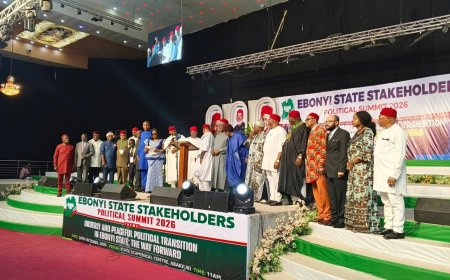
In Enugu State, Governor Peter Mbah’s one-form-one-candidate approach has introduced a different logic to this process. By allowing only one nomination form for one candidate for each elective position, the administration has effectively shifted party politics from costly internal battles to coordinated consensus-building. Rather than encouraging multiple aspirants to engage in financially draining contests, the system promotes early consultation, negotiation, and agreement within the party structure before the formal nomination process begins. In effect, it reduces the incentive for aspirants to dissipate resources in contests that may ultimately only formalize a prearranged political decision.
This model has significantly reduced the role of money in intra-party competition. Aspirants are no longer compelled to spend huge sums trying to outmaneuver one another for the attention of delegates, party leaders, or local political blocs. The political environment becomes less transactional because access to candidature is no longer determined by who can mobilize the largest war chest for internal contests.
Another major contribution of the approach is that it conserves political capital. Competitive primaries often leave behind grievances that weaken collective mobilization. Instead of uniting the party for the general election, they sometimes fracture it from within. The consensus-driven approach seeks to avoid this outcome. As Henry Ford put it, “Coming together is a beginning; keeping together is progress; working together is success.” By limiting destructive intra-party rivalry, the Mbah model strengthens internal cohesion and allows party actors to focus on shared political objectives.
Beyond party management, the approach also signals a broader reordering of political culture in Enugu State. It suggests that politics need not always be a theatre of expensive contests, symbolic confrontation, and predictable last-minute anointment. It can also be organized around efficiency, strategic coordination, and purposeful consensus. In this regard, John F. Kennedy’s famous reflection is instructive: “Change is the law of life. And those who look only to the past or present are certain to miss the future.”
Governor Peter Mbah’s candidate-selection approach therefore represents more than a nomination method. It reflects an attempt to modernize the internal mechanics of party politics in Enugu State. By reducing financial dissipation, curbing wasteful competition, promoting party unity, and introducing innovation into political organization, the model points toward a more disciplined and less monetized political culture. In that sense, it marks an important effort to reorder politics in Enugu from a system driven by costly internal struggle to one guided by coordination, efficiency, and strategic purpose.
Professor Odoziobodo is in the Political Science Department, Enugu State University of Science & Technology, Enugu.
What's Your Reaction?
 Like
0
Like
0
 Dislike
0
Dislike
0
 Love
0
Love
0
 Funny
0
Funny
0
 Angry
0
Angry
0
 Sad
0
Sad
0
 Wow
0
Wow
0