














































Solar Now Makes Up 20% Of Nigeria’s Electricity, Could Hit 50% By 2029 — REA
Nigeria is moving from being mainly an importer of clean-energy equipment to a regional supplier of renewable technology

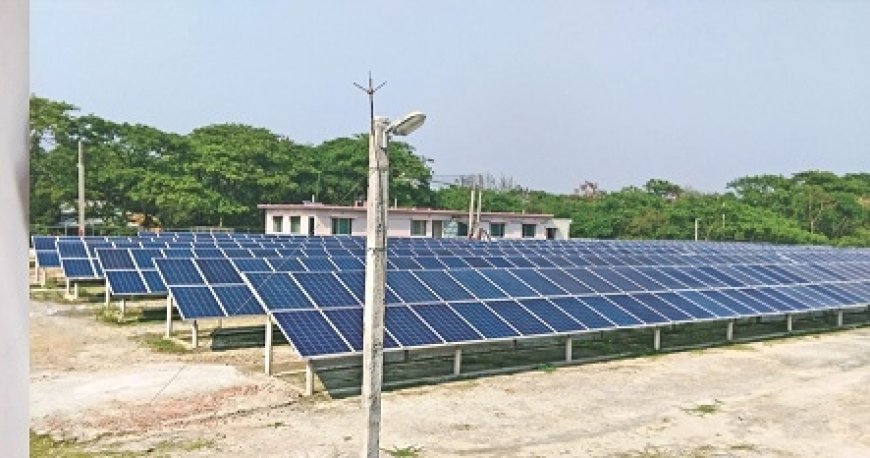
Solar power has grown to account for about 20% of Nigeria’s total electricity generation, and that share could rise to 50% by 2029 if current deployment rates and private-sector partnerships are sustained, the Rural Electrification Agency (REA) has said.


REA Managing Director, Abba Abubakar Aliyu, disclosed this on Thursday at the 25th Nigerian Oil and Gas (NOG) Energy Week in Abuja.
Speaking on the panel “Re-Engineering Africa’s Power Market Driving Reliable Energy Systems”, Aliyu said the rapid rise in solar was driven by increased deployment and stronger collaboration with private investors.
“Solar currently constitutes 20 per cent of the nation’s total generation capacity, and with the pace of deployment we are seeing, it is closing in on 50 per cent,” he said.
Aliyu noted that Nigeria is moving from being mainly an importer of clean-energy equipment to a regional supplier of renewable technology.
He said manufacturers in the Lagos–Sagamu industrial corridor are scaling up capacity to serve demand across West Africa, with Lagos-made solar photovoltaic (PV) panels already being exported to neighboring countries.
According to him, a pipeline of about 3.7 gigawatts of PV manufacturing capacity is under development to support further expansion.
“If you go to the Lagos–Sagamu axis, you will see manufacturing companies coming up,” he added.
Despite the growth in solar, REA and other industry leaders cautioned that gas-fired thermal plants remain critical to keeping the grid stable.
Managing Director/CEO of Transafam Power Limited, Vincent Ozoude, said gas is needed to manage the intermittency of renewables and provide baseline power for a growing population.
“The fluctuations in renewables make gas-fired thermal plants the quick fix to stabilising the baseline of the grid. If the gas-fired plants are not there today, no matter how much renewable investment we’re doing, we’ll go backwards,” he warned.
Panelists urged government and investors to pursue a dual-track investment strategy: expanding solar and local manufacturing, while also maintaining and upgrading gas plants.
They also called for investment in grid infrastructure to ensure new generation reaches consumers. Recommendations included:
- Digitalised smart-grid systems for real-time dispatch
- Additional high-voltage transmission lines to prevent stranded power
Speakers said combining expanded solar capacity, sustained gas support, and improved transmission would be key to turning increased generation into reliable electricity for millions of Nigerian households.
The REA’s projection signals a major shift in Nigeria’s energy mix, with solar set to rival gas as a dominant source within the next few years.
What's Your Reaction?
 Like
0
Like
0
 Dislike
0
Dislike
0
 Love
0
Love
0
 Funny
0
Funny
0
 Angry
0
Angry
0
 Sad
0
Sad
0
 Wow
0
Wow
0