




























ADC Candidate, Eze, Vows to Secure Federal Higher Institution for Igbo-Eze North/Udenu
The ADC candidate said his legislative agenda would focus on attracting strategic federal projects and institutions capable of creating jobs, expanding educational opportunities and stimulating economic activity across the constituency


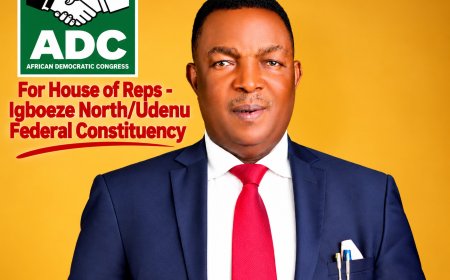
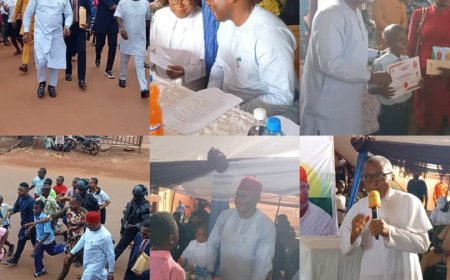
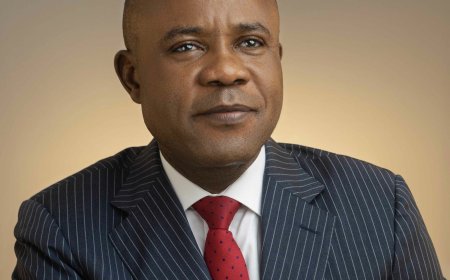
High Chief Benjamin Chimaobi Eze, the African Democratic Congress (ADC) candidate for the Igbo-Eze North/Udenu Federal Constituency, has pledged to pursue the establishment of a federal higher institution in the constituency, insisting that the people deserve more ambitious and measurable development from their elected representatives.


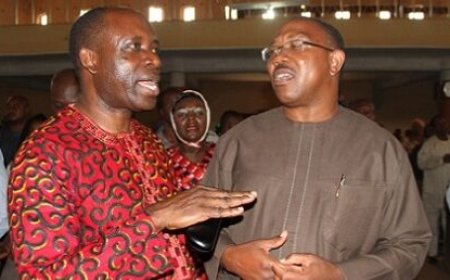
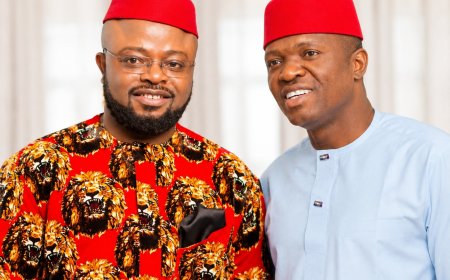
Eze made the commitment when the Igbo-Eze North/Udenu Conscience Group for Good Governance paid him a solidarity and courtesy visit at his country home in Obollo Eke, Udenu Local Government Area.
The ADC candidate said his legislative agenda would focus on attracting strategic federal projects and institutions capable of creating jobs, expanding educational opportunities and stimulating economic activity across the constituency.
Receiving the delegation, the coordinator of the group, Comrade Theophilus Onoja, said the visit was aimed at familiarising members with Eze as one of the prominent contestants from Udenu in the forthcoming election.
Onoja stressed that the group was not a partisan organisation but was committed to promoting peace, equity, justice and harmonious political relations across Igbo-Eze North and Udenu.
He urged political actors in the constituency to respect the 2019 power-sharing understanding, under which, according to him, candidates from Udenu stepped down in favour of aspirants from Igbo-Eze North.
The group maintained that the principle of equity should now guide the next phase of political representation, arguing that Udenu should be given the opportunity to produce the next member representing the constituency in the House of Representatives.
It also appealed to politicians who had previously occupied public offices to support a fair and orderly rotation of representation, particularly where previous tenures had not produced sufficient, measurable development outcomes.
Responding, Eze commended the group for what he described as its consistent advocacy for justice, equity and good governance in the constituency.
He said his legislative ambition would be driven by what he termed a human-centred development agenda, with emphasis on projects and policies that would have lasting socioeconomic impact rather than those designed merely for political visibility.
Eze argued that Igbo-Eze North/Udenu was long overdue for substantial federal investment and questioned why the constituency should continue to celebrate relatively small projects when other constituencies were attracting institutions capable of transforming their economies.
He cited the proposed Federal University of Agriculture in Ako-Nike, within the Enugu East/Isi-Uzo axis, and the Federal Polytechnic at Ohodo as examples of the type of federal institutions that, he said, could provide long-term educational, employment and economic benefits to host communities.
According to him, legislative representation should go beyond facilitating minor infrastructure projects to deliberately pursuing federal institutions, industries and programmes that would leave a lasting development footprint.
“We are tired of celebrating solar streetlights as major political achievements. Our constituency deserves functional, high-impact federal presence.
“As a legislator, I will push for the establishment of a federal higher institution in our constituency. Such an institution will create jobs, expand access to quality education, stimulate businesses and open new economic opportunities for our people.
“Our people must begin to demand more from those seeking their mandate. Representation should not be measured only by the number of streetlights installed, but by the institutions, opportunities and sustainable development brought to the constituency.”
Eze said he would pursue the necessary legislative and institutional engagements with relevant federal agencies and stakeholders to make the proposed institution a reality if elected.
He maintained that the constituency needed representation capable of converting its needs and aspirations into concrete federal interventions, rather than simply managing expectations with small projects.
He therefore called on voters to scrutinise the records, ideas and development plans of candidates and demand a legislative agenda capable of producing enduring benefits for present and future generations.
What's Your Reaction?
 Like
0
 Dislike
0
 Love
0
 Funny
0
 Angry
0
 Sad
0
 Wow
0