
































Why the bench warrant against Omoyele Sowore must be vacated
The court sequence raises profound concerns about procedural fairness, the right to liberty, and the administration of criminal justice in Nigeria.


BY ALOY EJIMAKOR


On June 15, 2026, Omoyele Sowore, a prominent activist, journalist, and presidential candidate of the African Action Congress (AAC), appeared at the Federal High Court in Abuja before Justice Mohammed Umar for a ruling on his motion for the judge’s recusal in the charge FHC/ABJ/CR/484/2025, but the learned justice was not on seat.
Sowore then informed the registrar of his scheduled travel to Lagos later that day and thereupon submitted a formal letter requesting fresh dates in July (specifically July 2nd, 3rd, 14th, 15th, 17th, etc).
Despite this, the court listed the matter for the very next day, June 16. Sowore, already in Lagos, could not attend, whereupon the Judge summarily revoked his bail and issued a bench warrant against him.
This sequence raises profound concerns about procedural fairness, the right to liberty, and the administration of criminal justice in Nigeria. It exemplifies how judicial discretion, when exercised without due regard for constitutional safeguards and equity, can undermine the rule of law.
The Nigerian Constitution is unequivocal on fair hearing. A core attribute of fair hearing is the audi alteram partem rule — hear the other side. Courts must afford parties an opportunity to present their case, including explanations for absence, before imposing sanctions like bail revocation or bench warrants.
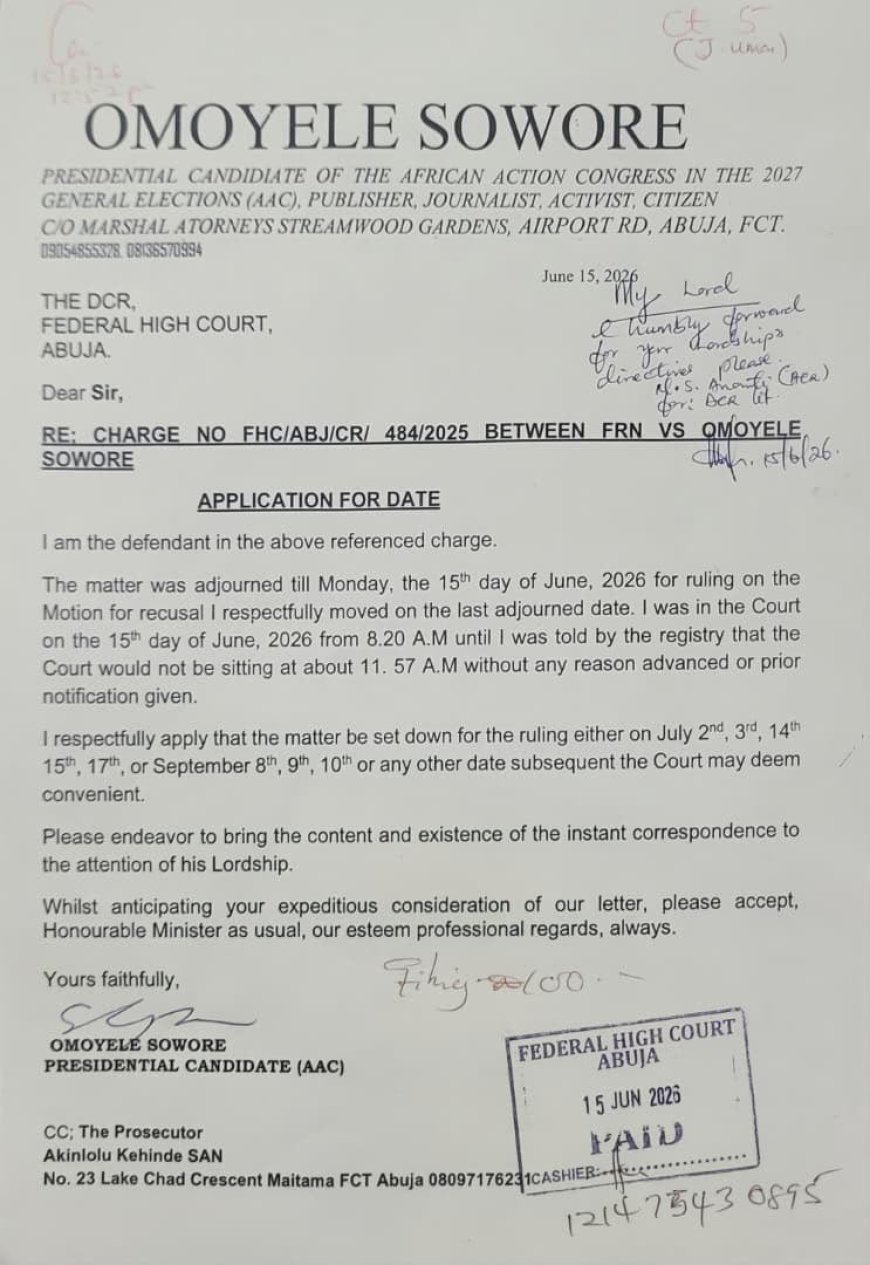
To be sure, the causal chain in this saga started with the Judge’s absence in a hearing the Judge himself scheduled for June 15, and at which Sowore was dutifully present. Despite this glaring fact that the Judge himself was the first to default, his Lordship added insult to injury by discountenancing Sowore’s letter that amply justified his absence from court the next day on June 16.
So, scheduling the matter for the immediate next day, despite documented notice of Sowore’s unavailability, raises a perception of personal vendetta or even an entrapment, especially as Sowore has an active application to recuse the same Judge.
The Administration of Criminal Justice Act governs such proceedings in federal courts. Provisions dealing with failure to appear typically require the court to consider whether “sufficient cause” or “reasonable excuse” exists for absence before resorting to bench warrant, which is a drastic measure. Unarguably, Sowore’s letter met or even surpassed sufficient or reasonable cause.
Issuing a bench warrant or revocation of bail is not automatic by the mere dint of a defendant’s failure to appear; it demands satisfaction that the defendant’s non-appearance was unjustified and that proper notice was given. In this very case, the notice of the next-day hearing was not even properly communicated other than by a vague text message sent to Sowore late on June 15.
In FRN v. Maishanu & Ors (2019), the Supreme Court addressed bail revocation, stressing that such actions must follow a community reading of relevant procedural provisions and occur only upon a clear breach. The Court underscored that this power be exercised with circumspection, as bail protects the presumption of innocence. Thus, revocation should only be a measured response to wilful evasion, not an absence formally notified to the court in writing beforehand.
To be sure, Sowore did not evade; he appeared on the scheduled date, documented his constraints, and proposed alternative dates. The Judge’s awareness of his letter made the next-day listing appear calculated to engineer non-appearance. This offends the principle that justice must not only be done but must manifestly and undoubtedly be seen to be done.
Bail is a constitutional safeguard for personal liberty pending trial. Revoking it summarily, especially in a politically charged case involving a vocal critic, risks perceptions of selective justice. Nigerian courts have repeatedly warned against using criminal processes to harass opponents. Sowore’s history of activism and prior encounters with the justice system does not justify bending rules; it demands stricter adherence to fairness to preserve public confidence in the judiciary.
The court could have adjourned, considered the letter formally and judiciously, or issued a proper hearing notice within the staggered dates suggested by Sowore. Instead, it opted for summary revocation and warrant - actions that portend severe implications for Sowore’s liberty, safety, and political activities as a presidential candidate.
Therefore, Justice Umar is hereby respectfully requested to - on his Lordship’s own motion - reconsider and vacate the bench warrant, restore Sowore’s bail, and ensure the recusal motion and trial proceed with scrupulous fairness. Anything less mocks the ideals of fair hearing and equal justice under the law.
What's Your Reaction?
 Like
0
Like
0
 Dislike
0
Dislike
0
 Love
0
Love
0
 Funny
0
Funny
0
 Angry
0
Angry
0
 Sad
0
Sad
0
 Wow
0
Wow
0