

































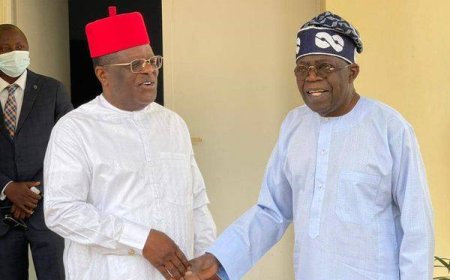




Between Memory and Ambition — The Uche Nnaji Question in Enugu’s Political Space
Former Minister of Innovation Science and Technology Uche Nnaji, who was forced to resign from office last year over alleged certificate forgery has refused to on a retreat of self renewal. Hired social media Rottweilers have refused to let Enugu people breathe and have been attacking real and imaginary "enemies" of their sponsor. They have also been promoting the governorship aspiration of Uche Nnaji in 2027 on the platform of the Peoples Democratic Party, PDP, a development considered bizarre by right thinking members of the social given the moral and legal burden hanging on Nnaji's neck.




By Ozoemenam Nnamani
In recent months, conversations across Enugu and beyond have taken on a familiar tone—one that blends disbelief, fatigue, and, in some quarters, indignation. At the centre of this discourse is Uche Nnaji, whose alleged governorship ambition for 2027 has sparked a wave of reactions, particularly on social media.
For many residents and observers, the unease is not simply about political aspiration—it is about timing, memory, and accountability in a society where public trust is already fragile.
A Controversial Exit Still Fresh
Nnaji’s resignation on October 7, 2025, as Minister of Innovation, Science and Technology under Bola Ahmed Tinubu followed allegations surrounding the authenticity of his academic credentials. Reports indicated that inquiries involving University of Nigeria, Nsukka raised serious questions about the validity of his degree, as well as his National Youth Service Corps certificate.
Though he stepped down, the episode left a dent not only on his personal reputation but also on public confidence in institutional vetting processes—especially given that such credentials had earlier passed through screening by the Senate and security agencies.
The Weight of Law and Constitution
Beyond public perception, the controversy touches on deeper legal implications. Under Nigeria’s Criminal Code Act, forgery is classified as a felony, attracting penalties that range from three years’ imprisonment to as much as fourteen years, depending on the nature of the document. Similarly, perjury—defined as knowingly giving false testimony under oath—can carry severe consequences, including up to fourteen years’ imprisonment or more in aggravated cases.
Crucially, the 1999 Constitution of Nigeria is explicit: individuals convicted of offences such as forgery or perjury are disqualified from contesting elections. While no conviction has been publicly established in this case, the legal framework underscores why the matter remains sensitive in the court of public opinion.
Social Media, Perception, and Political Messaging
What has intensified the debate is the aggressive push by online supporters promoting Nnaji’s potential candidacy. To critics, this campaign appears premature, even provocative—an attempt to reshape public memory through repetition and narrative control.
Supporters, on the other hand, may argue that political comebacks are not uncommon in Nigeria’s evolving democracy. Yet, opponents insist that such efforts risk deepening cynicism among citizens who already question the consequences of elite misconduct.
The Burden of Public Memory
Politics, by its nature, is unforgiving. As the saying goes in local parlance, once one steps into the arena, scrutiny becomes relentless. It's only in politics that one can be reminded who befriended his mother before she got married to his father, or worst still, who his real father is!!!
In this case, the controversy surrounding Nnaji has not faded into the background; rather, it remains a reference point in discussions about integrity and leadership.
For many, the issue is not whether a politician can rebuild a career—it is whether sufficient time, accountability, and restitution have taken place to justify a return to the spotlight.
Image Versus Substance
The discourse has also taken on a symbolic dimension. Critics have used metaphors such as “whited sepulchre”—drawn from Bible (Matthew 23:27)—to question whether outward appearances and renewed political messaging can truly mask unresolved concerns about credibility.
Such language, though sharp, reflects a broader anxiety about authenticity in leadership: the fear that image management may be replacing genuine accountability.
Redemption, Responsibility, and the Road Ahead
History offers examples of public figures who, after controversy, chose withdrawal, reflection, and eventual re-engagement. In contexts where trust has been eroded, time often becomes a critical ingredient for rehabilitation.
For Nnaji, the path forward—whether toward political relevance or quiet reinvention—will likely depend on how convincingly he addresses lingering questions. Calls for further scrutiny by institutions such as the Economic and Financial Crimes Commission and the Independent Corrupt Practices Commission also suggest that the story may not yet be fully written.
A Test Case for Accountability
Ultimately, the unfolding debate is larger than one individual. It speaks to Nigeria’s ongoing struggle to balance political ambition with ethical responsibility, and to determine whether public office is a privilege anchored in trust or merely a contest of resilience and reinvention.
As 2027 approaches, the question facing many in Enugu is not just who should lead—but what standards should define leadership in the first place.
What's Your Reaction?
 Like
0
Like
0
 Dislike
0
Dislike
0
 Love
0
Love
0
 Funny
0
Funny
0
 Angry
0
Angry
0
 Sad
0
Sad
0
 Wow
0
Wow
0